New Orleans, Louisiana native Rochelle Wilcox had a vision of building her fourth child care center, with this one right across from the park where she whiled away the hours as a youngster in Central City. They may call New Orleans “The Big Easy,” but it was anything but easy for Rochelle to access early-stage catalytic capital from mainstream financial institutions.
That’s when a determined Rochelle turned to LIIF, knowing our community development financial institution (CDFI) could fill gaps in the traditional financial market and figure how to make her entrepreneurial dreams a reality. So, as always, the LIIF Team rolled up their sleeves and put their expertise into action. The outcome was an intricate capital stack leveraging the New Markets Tax Credit (NMTC) program, a federal tool that drives investments into low-income neighborhoods by encouraging investors to put money into community-development entities; in return, the investor receives tax credits that reduce their federal income tax liability. The NMTC allocation was complemented by LIIF’s $2.75 million, eight-year, low-interest Brighter Futures Fund loan, which is a program supported by our strategic partnership with Goldman Sachs. As a value-add in an expensive housing market, Rochelle is co-locating her new center-based facility with four units of affordable housing, hitting two of LIIF’s strategic priorities. Talk about a community win.
We Are Capital Innovators
As was done in the case of Rochelle, capital innovation is paramount. That means early-stage capital to get projects kickstarted. Forgivable project-pursuit loans for housing developers so cash flow remains strong. Loans for in-home family child care providers on tight margins. These are just a few of the ways we create flexible products, based on in-depth conversations with community members, so we can best understand the unique needs of prospective loan or grant recipients.
LIIF leverages funders’ money to generate deep impact, knowing we are seen as trusted stewards of capital. We use philanthropy, foundation and bank dollars in creative ways, combining with traditional lending via our Revolving Loan Fund (RLF). We believe in the critical importance of intentionality to developing communities, and our purpose is about more than just moving money: It is fundamentally about expanding access to opportunity, to security and to economic mobility. This is the promise, and the power, of community development. Our key insight, borne out by our successes to date, is that perceived risk is usually much greater than actual risk when it comes to undercapitalized communities.
Examples of Capital Innovation
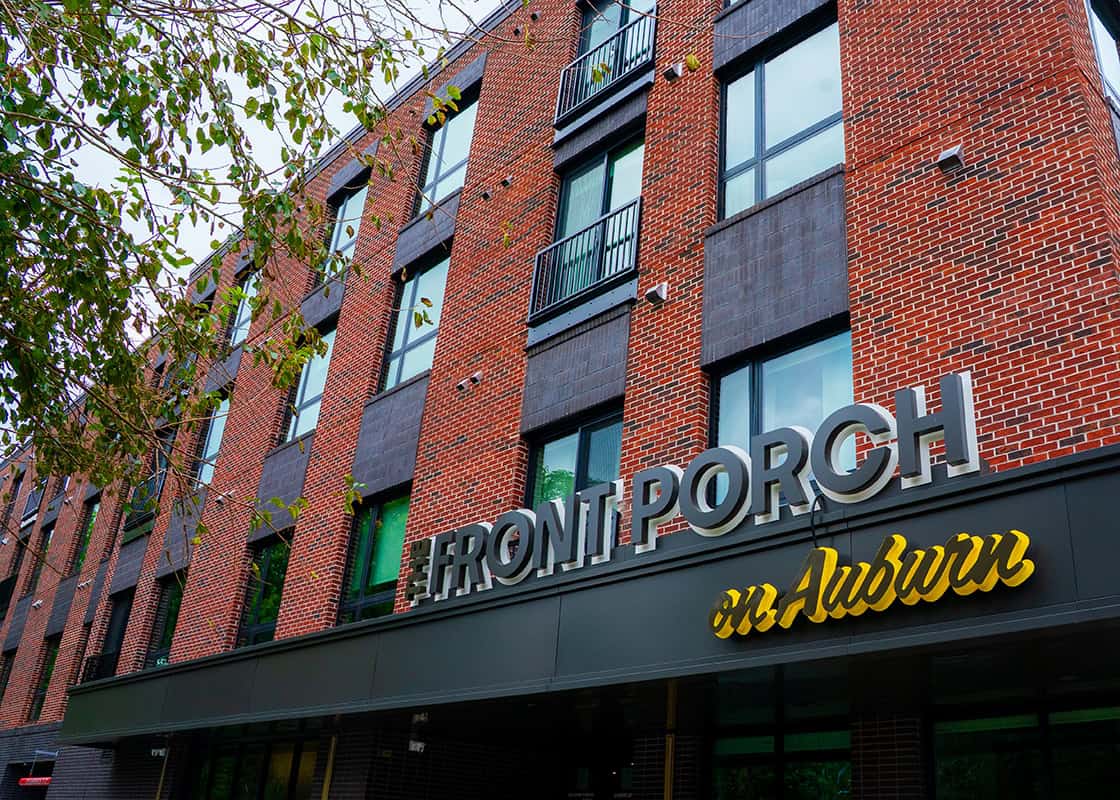
The 65 loans LIIF closed in Fiscal Year (FY) 25 highlight our resolve to remain leaders in capital innovation. Take the example of The Front Porch on Auburn (image at top) in the heart of Atlanta, Georgia. This infill venture replaced vacant land and parking lots with a mixed-use development along Auburn Avenue and was the first catalytic project on this storied Atlanta corridor in nearly two decades. LIIF provided a $4.5 million leverage loan and $8.5 million NMTC allocation to the Historic District Development Corporation (HDDC), co-founded 45 years ago by Coretta Scott King with a goal of revitalizing and rehabbing Sweet Auburn and its neighbor, Old Fourth Ward, both east of Downtown. This part of Atlanta was the center of the Civil Rights Movement, being where Martin Luther King Jr. was born and pastored at Ebenezer Baptist Church; currently, this community is home to a 35-acre park dedicated to MLK and his legacy, plus the King Center, where he is buried alongside his spouse. Despite attracting millions of annual visitors, the neighborhood has featured far-too-many closed storefronts. The hope is that Front Porch on Auburn, which offers co-living spaces at up to 80% AMI plus four commercial spaces, will be a transformative project. Front Proch honors the community’s rich heritage while building its vibrant future, and it took strategic partnerships and LIIF’s capital innovation to jumpstart the project.
Then there’s Rangel Houses in New York City, a public housing project in historically underresourced Morningside Heights in Manhattan. The eight-building development is named after the late Rep. Charles Rangels’ brother, a tenants’ rights activist. Genesis Companies, along with its partner Community League of the Heights (CLOTH), was selected by the New York City Housing Authority to redevelop the campus through the City’s Permanent Affordability Commitment Together (PACT) Program. The goal was the preservation of almost 1,000 units of affordable housing. That’s where LIIF stepped up, offering two predevelopment loans totaling $2 million to get the project off the ground. One predevelopment loan originated under Genesis Companies’ existing LIIF line of credit; and the second originated as an unsecured predevelopment loan through LIIF’s RLF. As a result, safe, quality housing is now on the way for the residents of Rangel Houses.
Finally, there’s the example of United Yards, located in the Back of the Yards neighborhood of South Side Chicago, Illinois. Stretching our national footprint, LIIF invested $5.35 million to two developers, Blackwood Development Group and Celadon Partners, to bridge the funding of a pair of grants from the City of Chicago: Chicago Redevelopment Program (CRP) and Tax Increment Financing (TIF). LIIF’s loans are part of a capital stack that also includes NMTC equity; a grant from the Chicago Community Trust; and two loans, side by side with LIIF’s funding, from peer CDFI IFF. This project rehabilitated the ground floor of the vacant 92-year-old Goldblatt’s department store. As a result of LIIF’s investment, there is now a 14,200-square-foot federally qualified health center (FQHC), Friend Health, which is moving from down the street to this new space where they can scale to include a pharmacy and behavioral health counseling. United Yards also includes a small-business incubator comprising four retail storefronts including a clothing store, coffee shop, bakery and barbershop. The upper floors of this building were previously converted into an affordable assisted-living facility.
A Look Ahead
The examples above are just a few case studies pulled from an enviable community-development portfolio built over 41 years. LIIF looks back on FY25’s capital innovation with pride and looks ahead as we drive community development across the nation, from red states to blue states, urban centers to rural towns, and everything in between.
We’ll do so via capital innovation.
LIIF leverages funders’ money to generate deep impact, knowing we are seen as trusted stewards of capital. We use philanthropy, foundation and bank dollars in creative ways, combining with traditional lending via our Revolving Loan Fund (RLF).