
In our ongoing goal to put forth the voice of the affordable housing developers LIIF supports, we recently interviewed the founders of Sepia Transformation Partners (STP), based in Atlanta, to hear how they are building communities of opportunity.
How and why was STP formed? What do you aim to achieve, and what is your mission?
The How:
Charlena Brown and Paul Robinson first met in 2012, near the launch of the U.S. Department of Housing and Urban Development HUD Rental Assistance Demonstration (HUD-RAD) Program. At that time, Charlena was working for Baker Tilly, a consulting firm specializing in affordable housing, while Paul was employed by a rural regional Low-Income Housing Tax Credit (LIHTC) development company, eager to engage with this new program aimed at converting public housing. Drawing on our combined experience and witnessing the HUD-RAD program’s growth — from 60,000 units initially to 455,000 units available for RAD conversions by 2021 — we identified a unique opportunity within the LIHTC sector. So we decided to establish STP, a company dedicated exclusively to rural and small housing authority RAD/LIHTC developments. STP is 100% African American owned and 50% woman owned.
The Why:
STP was established to leverage an innovative housing platform, HUD-RAD. We recognized an opportunity to apply our technical expertise, business-execution skills and development experience to revitalize public housing (some of which is 50 to 60 years old) in rural communities. Our goal is to transform these communities and improve the lives of their residents through this initiative.
The What:
STP offers affordable housing development and community transformation planning services tailored for small- and medium-sized public housing authorities. We specialize in helping these authorities recapitalize their existing public housing assets by leveraging LIHTC and HUD-RAD.
The Mission:
STP’s mission is to leverage the HUD-RAD program alongside other housing financial resources — including LIHTC, HOME and Community Development Block Grant (CDBG) funds, and local government funding — to redevelop public housing. This effort aims to transform the lives of public housing residents and revitalize the communities where they live. STP considers our work integral to the company’s core mission.
LIIF was recently involved in your Tanner Place affordable housing development in Canton, Georgia. Can you explain how LIIF’s early-stage capital proved catalytic?
LIIF’s early-stage capital was catalytic for STP, as we are a small startup lacking the financial capacity to cover large pre-development costs typical of LIHTC projects. LIIF’s predevelopment funding enabled us to pay for necessary third-party reports, plus LIHTC application submissions for Tanner Place and other developments. This support was essential for STP’s growth as an affordable housing developer, helping us secure competitive LIHTC awards.
Your company focuses on HUD-RAD. Can you explain how that program works and why preservation of existing affordable housing matters?
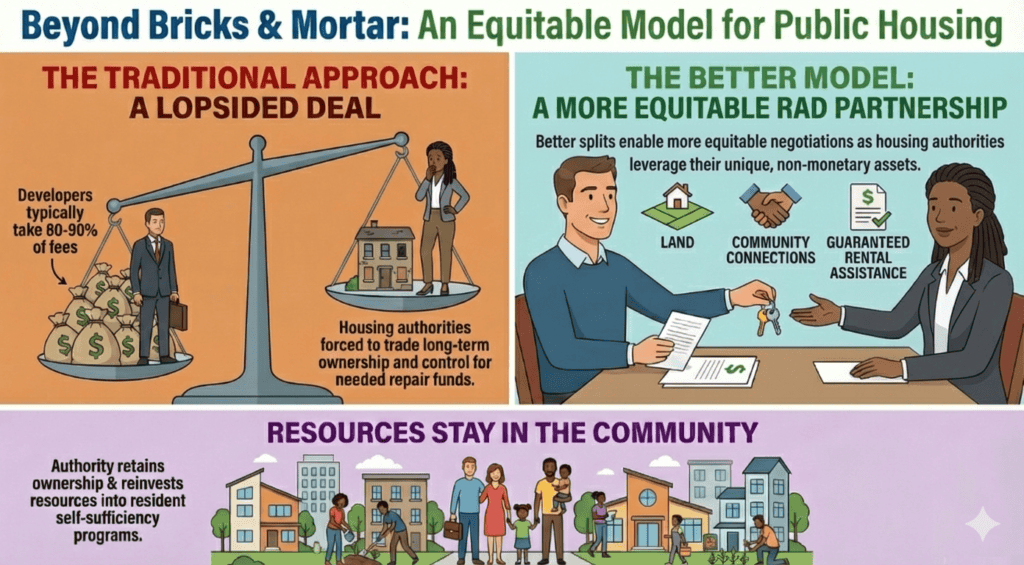
The HUD-RAD program addresses the significant deferred-maintenance backlog in public housing, which in 2012 was estimated at $25 billion for about 1.2 million units nationwide. RAD converts public housing to long-term Section 8 contracts and removes land-use restrictions, unlocking access to private capital needed for repairs and renovations. This preserves affordable housing, improves living conditions, prevents displacement and sustains community stability. Preserving public housing is critical because it provides safe, affordable homes to low-income families, seniors and vulnerable populations. The HUD-RAD program is so critical that sometimes we say RAD stands for “Republicans and Democrats” like it.
STP leverages the power of LIHTC to pencil out your deals. Can you explain how the LIHTC program works?
LIHTC is the primary federal tool for financing affordable rental housing development and rehabilitation. It incentivizes private investment by offering tax credits that reduce investors’ federal income tax liability. States receive annual tax credit allocations and competitively award them to developers whose projects meet affordability and community-impact criteria. Developers sell these credits to private investors to raise equity, reducing debt and enabling affordable rents. LIHTC projects must maintain affordability for at least 30 years, targeting households earning 60% or less of area median income (AMI). The program has created or preserved over 3 million affordable units nationwide since 1986.
You work in historically undercapitalized rural communities. What need have you seen in these rural areas?
Public housing is generally located in undercapitalized communities, often on less-desirable land such as flood-prone areas or near railroads and airports, with limited amenities. Rural communities face additional challenges such as scarce job opportunities, poor transportation, limited health care access, inadequate housing and infrastructure, flooding issues and weak broadband connectivity. For example, in a small town of 5,000 residents with 325 public housing units, about 20% of the population lives in, or is need of, public housing; therefore, the housing authority faces a substantial waiting list, highlighting the acute need for economic investment. STP’s combined effort with the housing authority is to invest in two RAD/LIHTC developments and a health and wellness park in which the combined total development cost is approximately $59 million.
STP looks to encourage young developers to be part of this sector. Why is that important to the future of affordable housing?
Encouraging young developers to enter affordable housing is vital for the sector’s future. Many young people seek purpose-driven work, and affordable housing offers a unique opportunity to “do good by doing good” through strong public-private partnerships. Young individuals often express interest in real estate careers and community transformation, but barriers to entry are high due to the complexity and lengthy timelines of affordable housing development. Despite these challenges, growing university programs focused on affordable housing signal hope for attracting and preparing new talent to address the massive housing need ahead. STP aims to contribute by sharing their experiences as a way to inspire mission-driven young professionals to pursue careers in the industry.
________________________________________________________
Connect with Sepia Transformation Partners:
Paul Robinson – Partner
245 N. Highland Ave. N.E., Suite 230 #866
Atlanta, GA 30307
paul@sepiatransformationpartners.com
(678) 801-3664
LIIF’s early-stage capital was catalytic for STP, as we are a small startup lacking the financial capacity to cover large pre-development costs typical of LIHTC projects.
Sepia Transformation Partner Co-Owners Charlena Brown and Paul Robinson