Hosted by Mindy Binderman, Chief External Affairs Officer
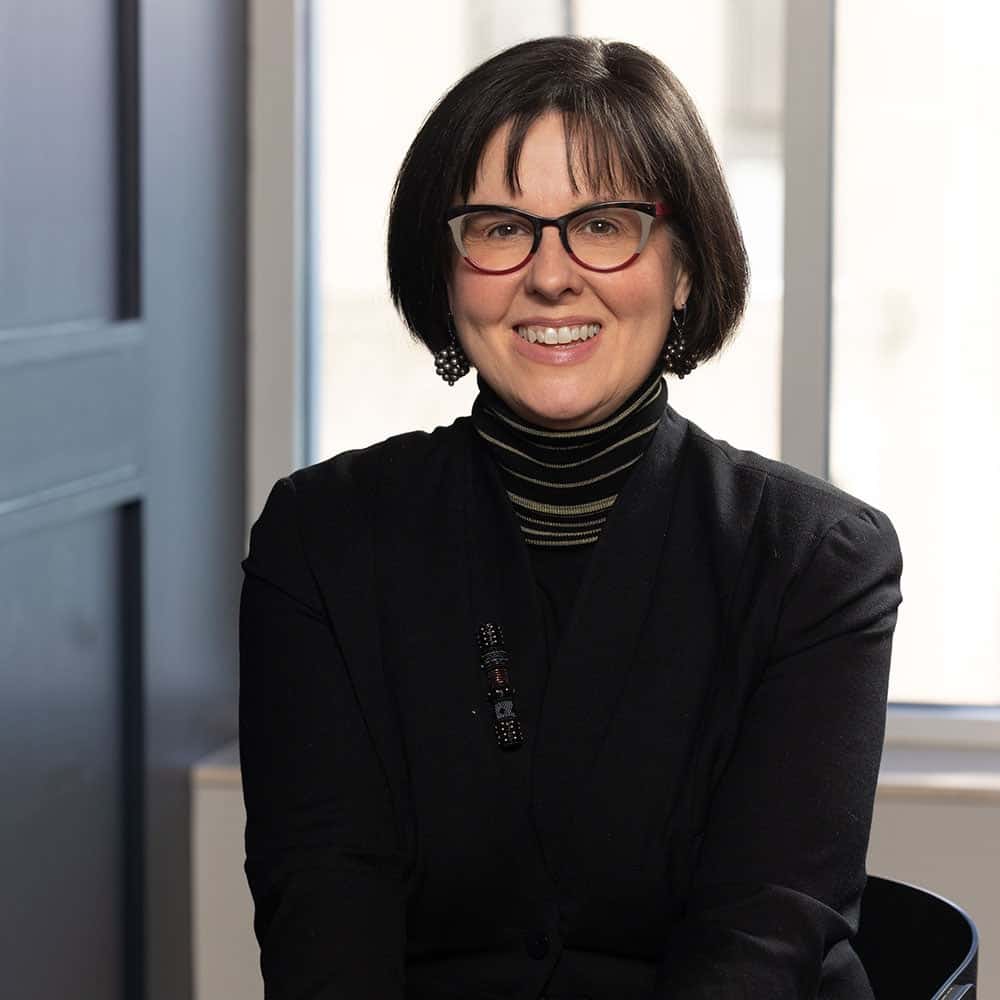
As Erika Poethig assumes her new role as LIIF’s Board chair, I sat down with her to learn more about her journey to LIIF and how she believes LIIF is uniquely positioned to lead. Erika is currently the Executive Vice President for Strategy and Planning, Civic Committee of the Commercial Club of Chicago.
Mindy Binderman (MB): We are excited to welcome you as LIIF’s new board Chair. I’ll start by asking: what brought you to LIIF and how your leadership journey has evolved?
Erika Poethig (EP): I’m going to step back to the early days in my career, back in the 1990s, when I worked for the City of Chicago Department of Housing. At the time, our most valuable partners in executing our work were the CDFIs that we partnered with in Chicago. We put public resources in funds led by Community Investment Corporation and Neighborhood Housing Services as a layer of capital. And it was through that partnership that I really came to understand what a terrific vehicle CDFIs are for bringing different capital sources together, including public sector capital sources.
Through that experience I became an enthusiast for the roles that CDFIs can play in knitting different sources of capital. And it’s why I’m so bullish on not just the kind of capital we receive today from state and local governments in the form of contracts, but on expanding the kinds of partnerships we have at the state and local level, maybe tapping state and local funds as guarantees or loan loss reserves or other ways in which that kind of capital can really help us scale.
MB: That leads to my next question: what are you most excited about taking on, both challenges and opportunities, and where do you see the future of LIIF going during your tenure?
EP: Clearly on the challenge front, there are a lot of headwinds for CDFIs at this moment with the Administration changing its policies and constraining resources for CDFIs. And while that puts a lot of fiscal pressures on the CDFI industry, it requires us to be sharper and make the case for the role that CDFIs play in communities. And the tailwinds, I think, are the opportunities to look to a variety of different partners. Our main partners have been the lending institutions that have a regulatory requirement and they’ve been hugely important. But with the headwinds, it forces a conversation about not only our capital sources, but also what they mean in terms of how we define ourselves as an organization.
During my first “chapter” on the Board, we were leading the field as one of the first CDFIs, if not the first, to execute a bond as a source of capital. We were finding new sources of capital for the lending, and it was a very exciting moment.
I think the tailwinds are the opportunities to think about our partners and our capital providers, where those sources of capital are coming from, how we tell our story and make the case to a new set of capital providers.
MB: That’s a great perspective, kind of like what’s facing the CDFI industry writ large. What do you think are the unique strengths that LIIF brings to the field? And how might we position ourselves?
EP: First and foremost, LIIF has a multidisciplinary, multi-sectoral point of view about what communities need to thrive, and we are very intentionally a national organization. And it’s so rare but it allows us to see the experience that Americans are having across different communities in the U.S. Our perspective is very distinctive and hugely important to the real lending that happens on the ground, but also in our discussions with policy makers or other CDFIs.
Looking forward, LIIF should continue to play a leading role in any kind of new tool development or other kinds of capital strategies. For example, we know that approximately 50% of U.S. births are occurring in the southeast, which leads you to ask how well children in those communities are doing and what is influencing their outcomes. Said differently, these communities are playing an out-sized role in the long-term economic mobility of the U.S. population.
What did LIIF do? We increased our presence in the southeastern part of the U.S., bringing much-needed childcare to those communities. We’ve also continued to push the envelope in terms of the kinds of lending we do—i.e. lending to more emerging developers in markets where we’ve been building out our presence.
MB: As we close out our discussion, is there something you want to share about how you hope to lead?
EP: I hope to tell the LIIF story by sharing how we build our national strategy from distilling lessons learned from our work on the ground into tools and lending that influence outcomes in many different communities across the U.S. I want to bring both my heart and head to this work because it’s a critical time to be disciplined but also to lead with empathy. It is an extremely challenging time for CDFI’s, and for that reason I think it’s critically important it is to be a compliment to the executive leadership by drawing out and leveraging the expertise and wisdom of the Board’s own leadership.
As Erika assumes the chair position, we also welcome three new members to LIIF’s board. Their expertise will continue to ensure that our organization is thoughtful and impactful for years to come.
Michelle Matthews is the Chief Strategy & Operations Officer for Purpose Built Communities Foundation, a nonprofit organization dedicated to implementing resident-centered, holistic neighborhood revitalization. As a senior leader, Michelle provides guidance to Network Members who implement the Purpose Built model as leaders, conveners, and catalysts of holistic transformational change at the neighborhood level.
Prior to joining Purpose Built in 2016, Michelle founded Matthews Consulting Group (MCG). For more than two decades, she served as a trusted advisor with expertise in organizational development, change management and consulting. Her passionate leadership has benefitted nonprofit organizations like Families First, the Task Force for Global health, and Communities in Schools of Atlanta. She also sits on teh Build Healthy Places Network Advisory Council.
Ron Schrager is Principal and Co-Founder of Eightfold Real Estate Capital, bringing more than 37 years of experience in real estate investment, management and finance. Before founding Eightfold, he served 18 years at LNR Property, ultimately as Chief Operating Officer, where he oversaw operations across multiple business divisions and led initiatives in special servicing, CMBS Investment and joint ventures. Earlier at LNR and its predecessor, Lennae Corporation, he directed asset management, due diligence, portfolio financing and international expansion efforts, including the establishing operations in Los Angeles and Tokyo.
Prior to joining LNR, Mr. Chrager was a Vice president at Chemical Bank (now JPMorgan Chase) in New York, where he managed a $300 million portfolio of restructured loans and originated complex real estate transactions. He began his career with the Boston Consulting Group and ICF Incorporated.
Shekar Narasimhan is the Managing Partner at Beekman Advisors, which he co-founded 22 years ago, has had over 100 clients and enabled over $5 billion of transactions. Prior to Beekman, he was in the real estate/multifamily lending business for several decades, including as Chairman & CEO of the WMF Group, a publicly traded, commercial mortgage financial services company. WMF was one of the largest such firms in the country before being acquired by Prudential in 2000.
In his civic life, Shekar has served on many public and nonprofit boards. Shekar is currently serving on the boards of the Democracy Alliance and Multifamily Impact Council Research Board of Trustees. He is also currently on the Advisory Council for the Bipartisan Policy Center’s J. Ronald Terwilliger Center for Housing Policy and the Economic Advisory Council of the Center for American Progress. He served until recently for over a decade on the boards of Broadstone Net Lease, Inc. (NYSE: BNL) and Enterprise Community Partners, Inc. and its subsidiary. In his public service, he has formerly served as Chairman and Commissioner for the Virginia Housing development Authority, on the Viriginia Board of Housing and Community Development and Commissioner on President Obama’s White House Advisory Commission of AAPIs. He is a sought-after speaker on housing finance and affordable housing and is considered a leading expert on renal housing issues in the United States.